
Frequently Asked Questions
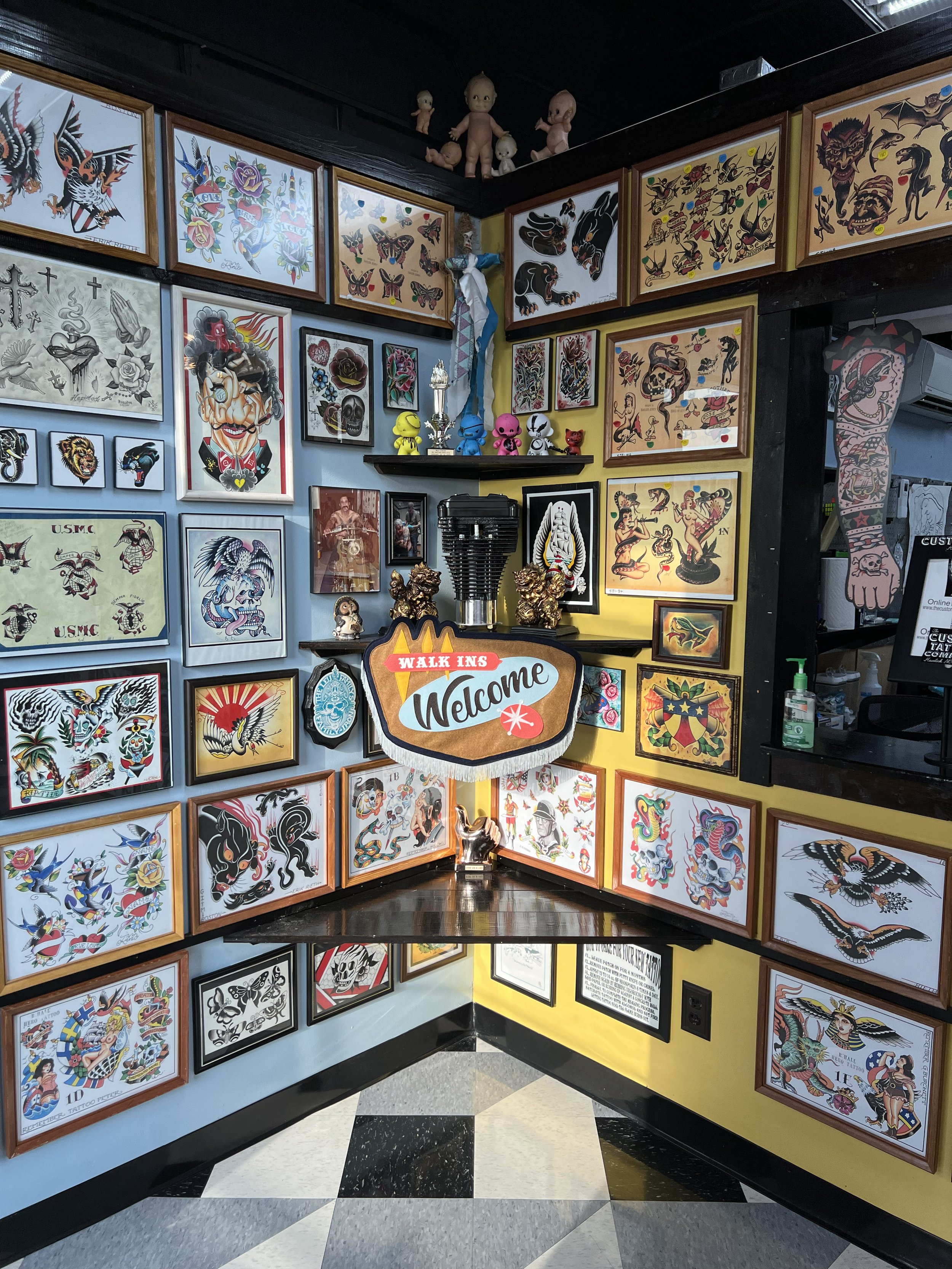
FAQs
Q: Where is the shop located?
A: Our address is
We are a grey and yellow building located directly across from the main gate to MCAS Cherry Point. Look for the duck or the big ass tattoo sign. You can’t miss us.
Q: Do you take walk-ins?
A: We sure do, 7 days a week.
Q: How do I make an appointment?
A: You can make an appointment by coming by the shop and speaking with an artist in person or you could start the process by filling out our Tattoo Request Form here.
Q: What methods of payment do you accept?
A: In God we trust but all others pay cash. There is an ATM located on site but it charges $3 for every $200 you pull out of it so plan accordingly.
Q: How much will my tattoo cost?
A: We charge by the piece, and draw for each client. Feel free to fill out our Tattoo Request Form here, or stop by the shop for a consultation.
Q: What is the Shop Minimum?
A: Shop Minimum is $100. This usually covers a small name or simple design with limited shading/color.
Q: What does a large Japanese project cost, like a sleeve or a back piece?
A: Large-scale Japanese work is quoted as a whole project and paid session by session, so you know the full scope before the first line goes on. Dave publishes his ranges openly: a full arm sleeve runs $3,000 to $4,500 per arm across about three sessions, a sleeve carried onto the chest panel $3,500 to $5,200 per side, a leg $5,000 to $7,000, a turtle back $4,000 to $6,000, and a full body suit between $19,000 and $33,000 depending on how much of the front gets covered. Those are ranges, not quotes. Your number depends on the design, the placement, the scale, and any existing work we are building around.
Q: Is a deposit required to book an appointment?
A: Yes, a $100 non-refundable cash deposit is required to book an appointment. This is deducted from the final price of your tattoo. Larger Japanese projects carry a bigger deposit, from $300 for a single piece up to $1,000 for a body suit, and that also comes off the total. If you need to reschedule for any reason your deposit is transferable with 24hrs notice.
Q: What happens to my deposit if I need to reschedule?
A: Give us at least 24 hours notice and your deposit moves with you to the new appointment. There is no limit on how many times you move it, and you do not have to put down a new one. A same-day cancellation or a no-show is a different situation, and the deposit is forfeited in both cases. That slot was held for you and there is no time left to fill it.
Q: How old do I have to be to get tattooed?
A: You must be 18 years old to get tattooed in the state of North Carolina. Even with parental or legal guardian consent, you cannot legally get tattooed under the age of 18 in the state of North Carolina.
Q: How long does a session take?
A: It depends on the work. A small single piece is usually one sitting, and you will get a time estimate when we quote it. Large-scale Japanese projects are booked as full-day sessions, because outlining a sleeve or laying in a background is not worth splitting across short appointments. If you are starting a big project, plan on giving up the day. You can eat, take breaks, and get up and stretch whenever you need to. Nobody does their best work rushed, on either side of the machine.
Q: How many sessions will my project take, and how far apart are they?
A: For large Japanese work the count is fairly predictable, because the process follows the same structure every time: outline first, then background, then foreground. A half sleeve is usually two to three sessions. A full arm sleeve is three to five sessions spread over two to four months. A leg sleeve runs four to six, a back piece five to eight, and a body suit is a multi-year commitment measured in dozens of sessions. Sessions sit about two to four weeks apart so the last one has time to heal properly before we build on it. Before each appointment you will know exactly what we are accomplishing that day.
Q: How does the design get made?
A: It starts with a conversation. You tell us the subject, where it is going, how much coverage you want, and any references you have collected. You do not need a finished idea. "Japanese dragon sleeve" is plenty to start with. From there the artist draws. You see the drawing the day of your appointment, and that is deliberate: the design is built for your body and your placement, so seeing it in the room with the stencil in hand is what lets us check size and flow against the actual spot. If something needs to change, we change it then, before anything starts. Nobody picks up a machine until you are happy with what is in front of you.
Q: Can I bring a picture of a tattoo I found online?
A: Bring references, absolutely. Photos of what you like, color directions, subjects, placement ideas, all of it helps and it is faster than describing things from scratch. What we will not do is copy another artist's tattoo line for line, or work from an AI generated image. The first belongs to the person wearing it. The second usually falls apart the moment someone has to turn it into something that will still read as a tattoo in twenty years. Reference is where we start. The drawing itself is ours, and it is built for your body and your placement.
Q: How do I care for my tattoo?
A: The life of your tattoo depends on the care it receives in the first 2 weeks. Your new tattoo should remain bandaged for a minimum of two to three hours. Remove the bandage and gently but thoroughly cleanse the area with antibacterial soap and water. Remove all surface blood and ointment. Pat dry with a clean towel, and let air-dry for 15 minutes, then apply a thin, even amount of white, scent-free lotion, such as Lubriderm or Aquaphor. Be sure to apply the lotion with clean hands. Too much ointment can suffocate your new tattoo and prevent it from healing properly. Less is more. Always default to less, not more. Wash and apply lotion no more than 3 times a day for 2 weeks.
Notes:
Do not re-bandage your tattoo
Do not pick, rub, scratch, or aggravate the area
Do not let your tattoo dry out
Do not submerge your tattoo in water for the first 2 weeks (no beach, pool, hot tub, sauna, or bath)
Do not expose your tattoo to direct sunlight or artificial tanning for 2 weeks
Do not apply rubbing alcohol or peroxide to your tattoo
Q: Is it normal for my tattoo to peel?
A: Yes. Peeling usually starts around day 3 to 7 and runs through the end of the second week. It flakes like a sunburn, and you may see bits of color come off with the dry skin. That is dead skin, not your tattoo. Do not pick it, pull it, or help it along. Let it fall off on its own.
Q: The colors look dull and cloudy. Did I ruin it?
A: No. While it is peeling there is a layer of dead skin sitting on top of your tattoo, so it looks milky and washed out. The real color comes back as that layer finishes shedding, usually 2 to 3 weeks. This is the most common worry we hear, and it fixes itself.
Q: My tattoo itches like crazy. What can I do?
A: Itching is normal healing and it usually peaks around week two. Put a thin layer of lotion on it, tap or pat the area, or hold something cool over your clothing. Do not scratch and do not pick. Scratching a healing tattoo pulls ink out.
Q: Is my tattoo supposed to scab?
A: A light, thin scab can be normal. Thick heavy scabs usually mean it got too much lotion or it took a knock. Either way, leave it alone. Picking a scab pulls ink out of the skin and leaves light patches behind. If a spot does heal light, we can look at it once you are fully healed.
Q: How do I know if my tattoo is infected?
A: Normal healing gets better day by day. What to watch for is anything that gets worse after the first two or three days instead of calming down: redness spreading past the tattoo, heat spreading out from it, pain that throbs and worsens after 48 hours, thick yellow or green pus, a bad smell, or fever and chills. If you see those, go see a doctor. That is a medical call, not a tattoo call. Itching by itself is just healing.
Q: Can I shower, and when can I swim?
A: Shower all you want. Just do not stand there and let the water blast it, and do not soak. Keep it short, pat it dry, thin layer of lotion. No submerging for the first 2 weeks. That means no pool, no hot tub, no lake, no ocean, no bath. Chlorine irritates a healing tattoo and open water carries bacteria.
Q: When can I work out again?
A: Give it a couple of days before you go hard, and longer if the tattoo is over a joint or a muscle that stretches, like an elbow, knee, or hand. Heavy sweat irritates the area and washes off your lotion. If you have a sweaty job, keep it clean, wash it again after you sweat, and wear something loose over it.
Q: Can I be in the sun?
A: Keep it covered and out of direct sun while it heals, about 2 to 4 weeks, and no tanning beds. UV burns healing skin and breaks down fresh pigment, which is what leaves a tattoo patchy. Do not put sunscreen on an unhealed tattoo, cover it with clothing instead. Once it is fully healed, sunscreen is the best thing you can do to keep it sharp for years.
Q: Do you do free touch-ups?
A: For sleeves and larger projects, a free touch-up session of an hour or two is already built into the plan. We book it about 6 weeks after your final paid session, and that session covers it.
For smaller tattoos, shop policy is one free touch-up within 6 months. Hands, feet, fingers, neck, face, and head are not included. Those areas fade and age faster than the rest of the body no matter how well they are done, so touch-ups there are charged.
Either way, we judge a touch-up once you are fully healed. Skin needs several weeks to settle before anyone can tell what actually needs work.
How to get tattooed
Come by shop any day of the week.
We’re open 12-7pm.
If we can’t tattoo you that day we can always book you an appointment
Fill out a tattoo request form to show and tell us your ideas. You can upload any reference photos you’ve been saving and we’ll get back to you about scheduling an appointment.